
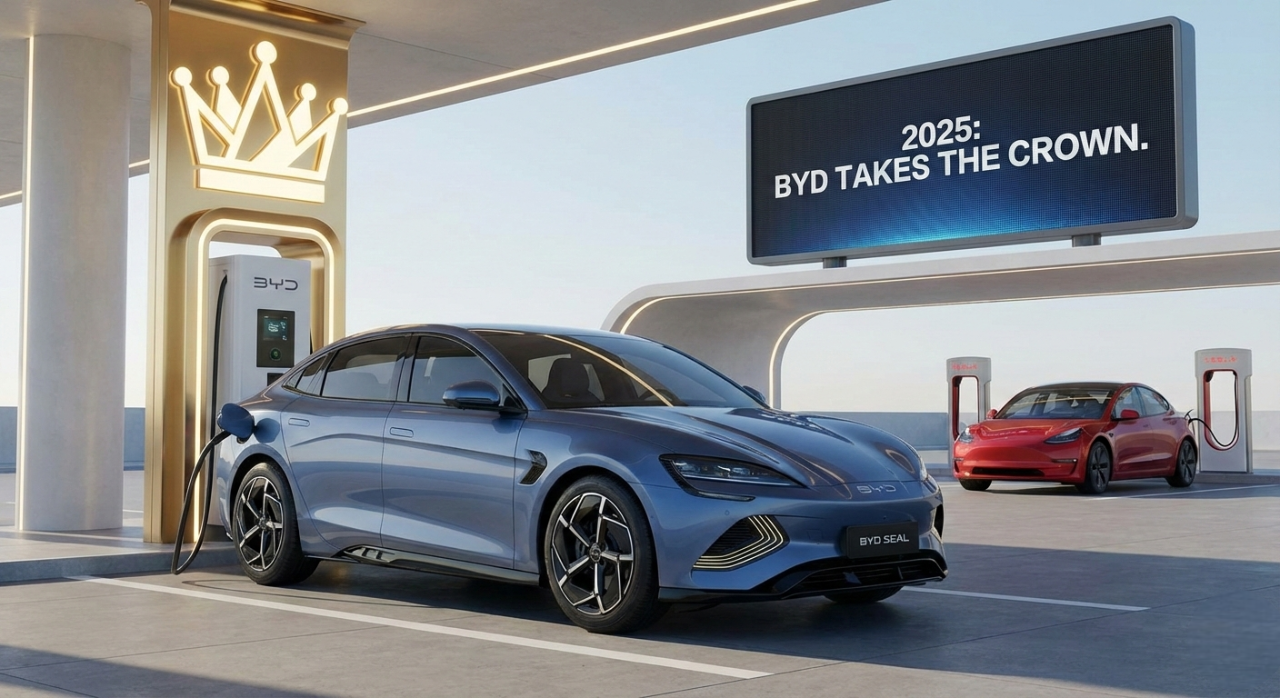
In 2011, Elon Musk chuckled dismissively when asked about China’s BYD as a competitor, replying, “Have you seen their car?” Fourteen years later, the numbers tell a different story: BYD sold 618,000 more all-electric vehicles than Tesla in 2025, marking a historic shift in the global automotive landscape.
The 2025 sales figures delivered a seismic shock to the electric vehicle industry. Chinese automaker BYD Auto sold approximately 2.26 million battery electric vehicles (BEVs) globally, a remarkable 28% increase from 2024. Meanwhile, Tesla reported deliveries of just 1.64 million vehicles, representing a 9% decline and its second consecutive year of falling sales.
This wasn’t merely a quarterly fluctuation but a fundamental realignment of market leadership that had been building for years. BYD’s ascent reflects broader changes in the global auto industry, where vertical integration, competitive pricing, and rapid international expansion have proven decisive against first-mover advantage.
1 Behind BYD’s Meteoric Rise
BYD’s path to the top is a story of strategic evolution and calculated expansion. Founded in 1995 as a battery manufacturer, the company leveraged its core expertise to become a fully vertically integrated automaker. This integration allows BYD to control costs throughout the supply chain, a crucial advantage in the price-sensitive EV market.
The company’s product strategy has been equally important. While Tesla focuses primarily on premium segments with limited models, BYD offers an extensive lineup ranging from affordable city cars like the Seagull to supercars under its Yangwang sub-brand. In China, BYD’s Qin L sells for approximately $16,500—almost half the price of a Tesla Model 3.
- Global Expansion: BYD’s international sales exceeded one million units for the first time in 2025, representing a massive 150% year-over-year increase. The company has made particularly significant inroads in Europe, where its sales more than tripled in 2025, while Tesla’s EU sales fell by nearly 40%.
- Technological Edge: Beyond pricing, BYD competes on innovation. The company has developed a five-minute fast-charging EV platform and includes advanced driver-assistance systems, which it calls “God’s Eye,” even on its most affordable models.
2 The Factors Behind Tesla’s Decline
Tesla’s sales drop to 1.64 million vehicles in 2025—including a concerning 16% decline in the crucial fourth quarter—stemmed from multiple converging challenges.
A significant factor was policy change in the United States. The expiration of the $7,500 federal EV tax credit in October 2025 created a demand vacuum, pulling sales forward into the third quarter and leaving a noticeable gap afterward. Tesla attempted to counter this by introducing lower-priced versions of its Model 3 and Model Y, but these models offered reduced range and fewer features.
Beyond policy, Tesla faced increasing brand challenges. CEO Elon Musk’s political activities and his involvement with the Trump administration sparked protests and boycotts, particularly in European markets where environmental consciousness often aligns with progressive politics. Some investors expressed concern that Musk’s diverse commitments—including leading SpaceX and previously running a government efficiency department—distracted from Tesla’s core business.
- Product Line Stagnation: Tesla’s reliance on just two main models—the Model 3 and Model Y, which accounted for approximately 97% of its production in 2025—left it vulnerable as competitors expanded their lineups. The Cybertruck has seen limited availability and demand, while promised vehicles like the next-generation Roadster remain delayed.
- Strategic Shift: Tesla has increasingly framed its future around autonomy and robotics rather than traditional car sales. The company has started limited robotaxi services in Austin and San Francisco and plans to produce humanoid robots called “Optimus”. While this vision excites some investors, it has coincided with declining automotive market share.
3 A Broader Market Transformation
The leadership change between BYD and Tesla represents more than just two companies trading places—it signals a fundamental shift in the global automotive industry.
Chinese automakers are rapidly gaining international ground. In 2025, BYD captured approximately 12.1% of the global BEV market, ahead of Tesla’s 8.8% and Volkswagen’s 5.2%. Beyond BYD, other Chinese manufacturers like Geely and SAIC are expanding globally, putting pressure on established Western brands.
The competition is particularly fierce in China, the world’s largest EV market, where approximately 150 car brands and more than 50 EV makers vie for customers. Even BYD faces intense pressure at home, with its domestic market share falling from 35% in 2023 to 29% in the first eleven months of 2025.
Interestingly, BYD’s total vehicle sales—including plug-in hybrids—reached approximately 4.6 million in 2025, though this represented its slowest growth rate in five years due to domestic competition. This contrasts with Tesla’s pure focus on battery-electric vehicles and highlights how diversified powertrain strategies can provide stability in transitional markets.
4 The Road Ahead for Both Giants
Looking forward, both companies face distinct challenges and opportunities as the EV market continues to evolve.
BYD’s 2026 strategy involves aggressive international manufacturing expansion, with new production facilities in Turkey and Hungary expected to open soon and Spain under consideration. These plants will help circumvent tariffs and strengthen the company’s European presence. BYD aims to sell 1.6 million vehicles outside China in 2026, up from approximately 1.05 million in 2025.
Despite its sales leadership, BYD must address declining profitability, having reported profit drops in both the second and third quarters of 2025. The company’s founder, Wang Chuanfu, has acknowledged that BYD’s technological lead has eroded and promised new innovations soon.
Tesla’s future, meanwhile, appears increasingly tied to its autonomous driving ambitions. The company’s share price reached record highs in 2025 largely based on optimism about its robotaxi and self-driving technology rollout planned for 2026. Analyst Dan Ives of Wedbush Securities projects Tesla could own about 70% of the self-driving market over the next decade.
However, Tesla’s automotive business faces immediate challenges. Wall Street analysts have lowered their 2026 sales estimates, reflecting a gloomy outlook for near-term vehicle deliveries. The company’s goal of producing 4 million cars by 2027 now seems increasingly unlikely.
| Global Electric Vehicle Sales (2025) | BYD | Tesla |
|---|---|---|
| Battery Electric Vehicles (BEVs) | 2.26 million | 1.64 million |
| Year-over-Year Change | +28% | -9% |
| Total Vehicles (including hybrids) | 4.6 million | 1.64 million (BEVs only) |
| Key Growth Market | Europe (sales tripled) | Limited growth, facing headwinds |
The transition at the top of the EV market represents a new phase in the electric revolution—one defined by manufacturing scale, regional strategies, and diversified approaches to electrification rather than first-mover advantage alone. As BYD cements its volume leadership and Tesla pivots toward an AI-driven future, consumers worldwide will benefit from accelerated innovation and increasingly accessible electric transportation.
The road ahead promises continued transformation, with traditional automakers, tech companies, and startups all vying for position in what has become the most dynamic sector of the global economy.


